
 EN



Why Sciatica Needs a Different TENS Setup
Sciatica is not a single point of pain. It is a symptom pattern that follows the path of the sciatic nerve, often starting in the lower back or buttock and radiating down the back of the leg. That long, linear distribution changes how a tens unit should be set up. A standard low back placement may miss the nerve pathway entirely. The stimulation needs to cover the route where the pain actually travels, not just the spot where it feels worst.
The underlying cause also matters. Sciatica can come from a disc herniation, spinal stenosis, piriformis syndrome, or other sources of nerve irritation. A TENS unit does not treat the cause. It modulates how pain signals are processed. That distinction shapes expectations. The device can reduce the intensity of the radiating pain for some users, but it will not shrink a herniated disc or reopen a narrowed canal. Anyone with progressive weakness, loss of bladder control, or severe unrelenting pain should seek medical evaluation rather than self-treat.
Mapping the Pain Path Before Placing Electrodes
Electrode placement for sciatica starts with a simple map. Ask where the pain begins, where it travels, and where it ends. A typical pattern runs from the lower back through the buttock, down the posterior thigh, and into the calf or foot. The electrodes should bracket that path rather than sit only on the lumbar spine.
A practical approach is to place one pair of electrodes near the origin of the pain, often just lateral to the lower lumbar spine or over the buttock, and a second pair further down the leg along the symptomatic route. For users with a single-channel device, placing both electrodes along the most painful segment of the nerve path often works better than a generic back placement.
The table below compares common placement strategies and their practical tradeoffs.
| Placement Strategy | Typical Use Case | Advantage | Limitation |
|---|---|---|---|
| Parallel to lumbar spine | Central low back pain | Familiar and easy | May miss radiating leg pain |
| Buttock to posterior thigh | Classic sciatica path | Covers the nerve route | Requires longer lead wires |
| Around the knee or calf | Distal symptoms | Targets the most painful segment | Less effect on proximal pain |
| Dermatomal bracket | Mixed patterns | Follows nerve distribution | Needs basic anatomy knowledge |
Skin preparation still matters. Clean, dry skin improves adhesion and current distribution. Hairy areas may need trimming rather than shaving. Electrodes should sit flat, with edges pressed down, and lead wires should have enough slack to avoid pulling when the leg moves.
Electrode Placement Along the Sciatic Nerve Route
The sciatic nerve runs deep, so surface electrodes do not stimulate the nerve directly. They recruit nearby nerve fibers and trigger the gate control mechanism in the spinal cord. That is why placement along the pain path can work even though the current does not reach the nerve itself.
A common mistake is placing electrodes too close together over the point of maximum pain. That concentrates current near the surface and can feel sharp without covering the broader distribution. Spacing electrodes several inches apart along the nerve route often produces a more comfortable and more useful session.
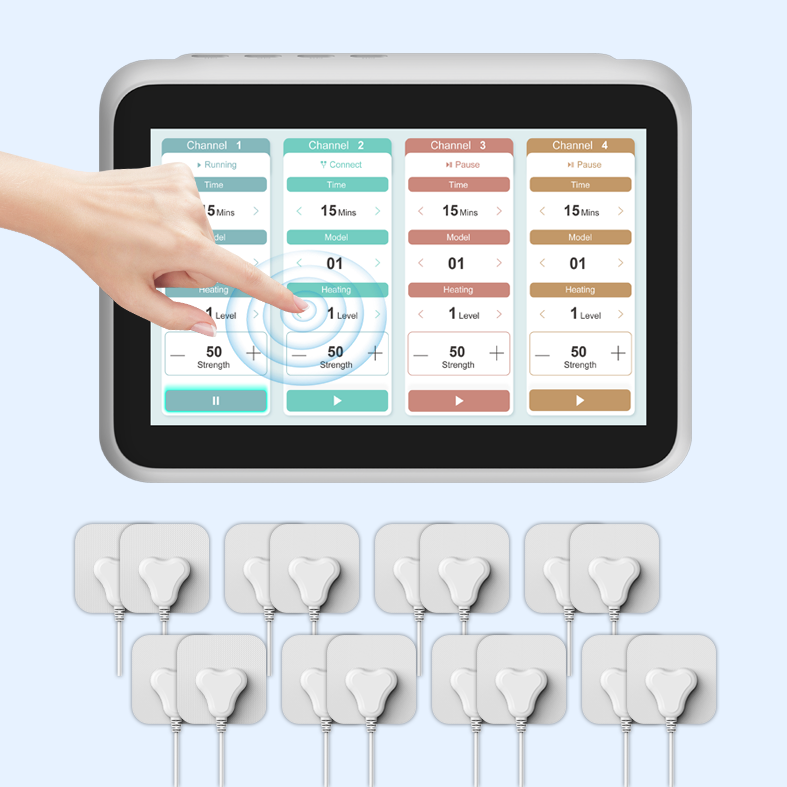
For users with two channels, a reasonable starting setup is one channel over the lower back or buttock and the second channel over the posterior thigh or calf. The intensity on each channel can be adjusted separately, which helps when the pain is stronger in one segment than another.
Choosing Frequency and Intensity for Nerve Pain
Sciatica often has a neuropathic quality, described as burning, shooting, or electric. Clinical experience suggests that higher frequencies, roughly 80 to 120 Hz, are a reasonable starting point for this type of pain. Lower frequencies around 2 to 10 Hz may help with the aching, muscular component that often accompanies nerve irritation, but they are less likely to cover the sharp radiating sensation.
Intensity should be raised slowly until a strong but comfortable tingling appears. More intensity is not better. The goal is to activate large-diameter fibers without triggering a painful muscle contraction or skin irritation. Session length is typically 20 to 30 minutes, and shorter, more frequent sessions may work better than one long session.
A Cochrane review of randomized trials found moderate-quality evidence that TENS reduces pain intensity in chronic musculoskeletal pain compared with sham stimulation, but evidence specific to sciatica is more limited. That is an honest limitation. A trial-and-error approach with careful notes on placement, frequency, and response is more useful than expecting a fixed program to work immediately.
A Rehabilitation Case Where Placement Changed Outcomes
A rehabilitation clinic in southern China treated a group of patients with chronic sciatica who had not responded well to standard TENS placement over the lower back. The initial protocol used two electrodes on either side of the lumbar spine at 80 Hz for 30 minutes. Roughly a third of patients reported meaningful relief, and many described the stimulation as pleasant but not helpful for the leg pain.
The team changed the setup. One channel stayed over the buttock near the presumed origin of the irritation. The second channel was moved to the posterior thigh along the most painful segment of the radiating path. Frequency stayed at 80 to 100 Hz for patients with sharp, shooting pain, while those with a deeper aching component were switched to a mixed setting or a lower frequency on the second channel. Patients were asked to rate leg pain separately from back pain.
After eight weeks, the proportion reporting at least 30 percent reduction in leg pain rose from about one third to more than half. The device hardware did not change. The placement and the separate channel tuning did. That outcome reinforced a simple point. Sciatica is a path, and the stimulation setup should follow the path.
Safety Limits and When TENS Is Not Enough
A tens unit is not appropriate for every case of sciatica. People with implanted electronic devices such as pacemakers or spinal cord stimulators should not use TENS without medical clearance. Electrodes should not be placed over the eyes, the front of the neck, the head, or broken skin. Pregnant users should consult a healthcare provider before using TENS on the abdomen or lower back.
Red flags matter more with sciatica than with many other pain patterns. Progressive leg weakness, numbness in the saddle area, loss of bladder or bowel control, or pain following a significant trauma require urgent medical assessment. TENS should not delay that evaluation.
Responder rates are another honest limitation. Roughly 20 to 30 percent of users report little or no benefit, and there is no reliable pre-test to predict who will respond. Electrode quality also affects results. Worn or low-cost electrodes with uneven conductivity can cause hot spots and inconsistent stimulation. Medical-grade hydrogel electrodes tend to produce more predictable sessions.
For partners building tens unit products for nerve pain applications, setup guidance and manufacturing consistency both matter. SUNMAS, the core brand of Hong Qiangxing (Shenzhen) Electronics Co., Ltd., has been manufacturing home medical therapy devices since 2003. The operation includes a 5,000 square meter automated production facility, a 30-engineer R&D center, and a 150-member quality team. Its quality management system is certified to ISO 13485 and MDSAP, and selected products carry FDA 510(k), Medical CE, and UL certifications. That combination of production capacity and regulatory coverage helps turn a well-designed TENS concept into a product that can meet the testing and supply chain demands of international buyers.

